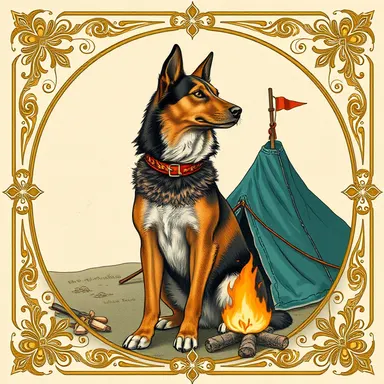
Year of İt
Meaning: dog
A short history
The Bilge Kagan inscription records the kagan's death in the "it yıl" (year of the dog, 734). As the animal that guarded the herd and the camp, it is a symbol of loyalty.
Cultural background
The dog is the first friend that guards the camp and the flock, and it stands as "it" in the Kazakh calendar too. The image of loyalty and protection comes from this daily duty. It is the eleventh year in Kashgari's list; in the Göktürk period the same name was used to date a kagan's death, so it was not only a folk name but also entered state records.
Symbolic qualities
- loyal
- fair
- protective
- sincere
İt is the symbol of loyalty that stands behind its word. It cannot bear unfairness and protects what it trusts. Its shadow side is sliding into suspicion and taking everything on alone.
Things you might reflect on
- To whom or what are you loyal, and does that loyalty also look after you?
- In a situation you find unfair, what might be good for you to do?
- How easy is it for you to ask for help?
Years it falls on
Each year begins on 21 March and ends on 20 March of the following year.
1910 · 1922 · 1934 · 1946 · 1958 · 1970 · 1982 · 1994 · 2006 · 2018 · 2030 · 2042 · 2054 · 2066 · 2078 · 2090
Chinese counterpart: Dog →Where does the Turkic 12-animal calendar come from?
In the Divanu Lugati't-Türk, written in the 11th century, Mahmud of Kashgar explains that the Turks counted years by the names of twelve animals and lists them in order. The work also tells a story about the origin of the cycle: of the animals driven into the Ila (Ili) river before a ruler, the names of the twelve that crossed were given to the years.
An older witness is the Orkhon inscriptions (8th century). The Kül Tegin inscription dates his death to the "koń yıl" (year of the sheep, 731) and the Bilge Kagan inscription dates the kagan's death to the "it yıl" (year of the dog, 734). So animal year names were already used to give dates in that period.
The cycle follows the same order as the Chinese calendar and is a heritage shared with neighbouring cultures. Sources reckon the start of the year differently; this page takes Nevruz (21 March) as the start of the year.
- Kaşgarlı Mahmud, Divanu Lugati't-Türk (1072–1077).
- Kül Tegin yazıtı (732) ve Bilge Kağan yazıtı (735), Orhun Vadisi.
- Erkoç, H. İ., Divanü Lugati't-Türk'te Vahşi Hayvanlarla İlgili Kelimeler ve Terimler, Hacettepe Üniversitesi Türkiyat Araştırmaları Dergisi 23 (2015), 177-208.
- Karimova, G. ve Türkmen, F., Kazakistan'da Hayvan Kültü ve 12 Hayvanlı Halk Takvimi (2022).
The twelve animals
For entertainment and self-reflection. Year animals are presented as cultural history and character symbolism; they do not tell you what a year holds.
The images on this page were generated with AI.